todays news

In the process of deciding which of the semester's work should end up in my portfolio. Super proud of this guy, though:

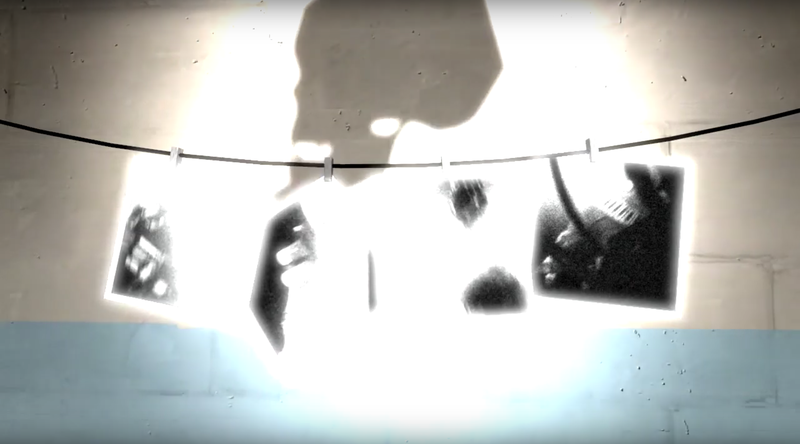
The project itself has its roots in my interest in mashing up data streams to create ‘live’ art, ephemeral digital objects that update themselves based on changing criteria. Earlier this year I’d written a Processing application called todays news which utilized the New York Times’ XML feeds to create new images, headlines and color schemes based on the current news. Headlines were generated via a Markov Chain algorithm built into the RiTA text-processing library. ‘Markov’ images were created by sampling a fraction of each image and recompiling it into a whole. Background colors palettes were created by taking color samples from each of the major images on the front page. The result was an ever changing composition- sometimes oddly meaningful, sometimes absurd- that was both generated by the artist in collaboration with the machine, via algorithm, and yet more importantly, by the data itself. The result is inherently political and yet entirely without prejudice.

todaysNews:

todays news, 2013

Agon.

I've been prepping an essay on the commodification of gameplay, on a nasty trend in design that turns our voluntary impulse to play into a capitalist urge to produce. I went digging around in some old essays and dug up this, provided without edits. Thoughts on difficulty:

Agon: Or why I’d rather eat my controller than “play” Farmville.

In Man, Play and Games, Roger Callois defines games of Agon as “games which seem to be competitive...like a combat in which equality of chances is artificially created” (Callois, 14). While most digital games, by virtue of being positioned around skill rather luck, fall under Agon, Super Meat Boy, Gundemonium and Jamestown most certainly typify the distinction.

Gundemonium and Jamestown both belong to a little cult-genre called Bullet-Hell Shmups. They throw endless waves of projectiles at the player and the player, in turn, need a certain kind of sadomasochistic devotion to succeed at them. At first glance we presume them to be speedy action games, when in reality they rely on a combination of memory and reflex to succeed.

I bring this up because it represents an important shift in the kind of challenge the player participates in. In Braid, the game is explicitly about the player versus a system. During a talk at USC, the interaction designer Yasser Malaika noted that in a puzzle game, you always expect the player to succeed. In fact, if the player fails at solving the puzzle despite an utmost attempt, then the designer has failed to create a good game.

SMB, Jamestown and Gundemonium represent a different paradigm, one in which a player essentially squares off against herself. In all 3 games, the enemy patterns are fixed, the bullets always launching at the same angles, the saws fixed in distinct cycles. The x factor is the player’s willingness to devote the time and energy into memorizing and reacting to the game. Any one of us, given enough hours, could 100% complete Super Meat Boy. Although, as of this writing only 2.8% of Steam players have actually achieved that goal. This kind of challenge is what Bogost refers to as “Mastery” and goes on to note that Mastery is “a highly specialized carrot that works only in extreme circumstances. Indeed, the ludic sublime is probably a very rare terrain” (Bogost, 133).

Which is to say that this kind of aggressive, inward challenge requires private, personal dedication, but that it also reveals something exquisite. In The Art of Game Design, designer Jesse Schell talks about Flow, a concept put forth by the inscrutably named Mikhail Csikszentmihalyi, noting that its characterized by a state of “sustained focus, pleasure and enjoyment” (Schell, 118). Further, he discusses the Flow Channel ,the “margin of challenge that lies between boredom and frustration” (Schell, 119). YouTube is awash with Super Meat Boy videos that come from players in deep states of Flow, as the later levels practically demand it- Meat Boy must be in a state of constant motion, the player fully committed to both this moment and the next and what's past is past. Its a state of participatory inertia which cannot relent.

Games of Agon often invoke Flow states by forcing us to overcome ourselves, to improve our own abilities. Early gaming was nearly entirely Agon-focused, often punting players back to the title screen for failing to complete the game in a single go and rewarding the kinds of obsessive, ritual play that left us with the cultural view of the gamer as a glassy eyed basement dweller. In response, we’ve seen not only a rise in “casual” games, but the gradual softening of even more traditional Agon games. Checkpoints are frequent, difficulty is adaptive and some games, like last year’s New Super Mario Bros., will even “auto-play” the player through difficult sections. Indeed, the surprise cult hit Dark Souls was lauded for its return to difficult, punishing gameplay, forcing the player to repeat sections of the game until they could perform a near perfect ballet and wield their Mastery. It goes without saying that it wasn’t for everyone.

As a kid, I remember biting my controllers in agonized frustration when I’d fail to meet the challenge,. These days, my controllers have fewer bite marks in them these days and I can’t remember the last time I actually threw one across the room. As I got older, I stopped finding Mastery particularly worthwhile. Bogost’s other end of compelling play is Habituation, which he describes as “likely to relate to biding time or zoning out more than it is to encourage increased performance” (Bogost, 129). This is less about Flow and more about a lazy river, then. And there’s nothing wrong with this as Johan Huizinga in Homo Ludens says that “Nature... gave us play with its tension, its mirth and its fun” (Huizinga, 3).  I think most of us have reached a point (Almost certainly with this week’s games) where playing ceases to be fun, it becomes a slog and a kind of commitment which we do not feel free to abandon, violating Callois’ tenet that “play must be defined as a free and voluntary activity” (Callois, 6). Habituation, in opposition to Mastery,  is about comfort..

Its from this revelation that a nasty strain of games began to emerge in the last 5 years, games built so entirely around Habituation as to become not games at all. While a case could be made that many MMO’s launched the style, the premiere offender in the public consciousness was Farmville, a game which contains no challenge at all. It is most certainly not a game of Agon, and its finely tuned balance makes it the polar opposite of Ilea. Nor is it Mimicry, as none of its mechanics or gameplay reflect the reality of agriculture and it is the brutal, slothful opposite of Ilinx. Habituation, as Bogost posits it, is about the almost nostalgic joy of recognizing something in play, of seeing a familiar mechanic brought to life in a new way. Its about knowing what to expect, about taking comfort in that.

Farmville is a savage perversion of the concept, as it turns the hooks of Habituation against the participant (Here, I refuse to invoke the word player, as I don’t believe any play occurs), forbidding them from interacting unless they possess game currency and then having them wait to get more. Further, the result is consistent and mapped against a gameplay model that doesn’t much care for participant input. It is carefully arranged to put the player on a track, deterministic and certain. Indeed, one might almost expect to find Baruch Spinoza listed among the designers, as the participant’s only true freedom is to know that their linear progress is assured, and how to reach it, but never to accelerate or alter it.

Farmville and its ilk are a cynical reading of the opposition to Mastery and games of Agon. It believes that the horizon beyond Habituation is nothing but naked impulse, that the player would be just as satisfied to sup at sugar water as to sit in the Flow Channel. It believes in a formality of rule and action that supersedes even Callois’ ludus. In the chapter “Corruption of Games”, Callois writes, “the rule of instinct again becoming absolute, the tendency to interfere with the isolated, sheltered and neutralized kind of play spreads to life and tends to subordinate it to its own needs as much as possible. What used to be a pleasure becomes an obsession. What was an escape becomes an obligation, and what was a past time is now a passion, compulsion and source of anxiety.” (Callois, 45). In as far as the “game” requires the participant to be involved, to make money for the parent company, it requires this. It requires anxiety, obsession and obligation. Mastery, as compelling and devotional as it can be, ultimately allows us to overcome the challenge, to become better and free ourselves of the need to compete. In the absence of challenge or even of play, we strike in a vacuum, we become the lords of nothing and Masters of none. In the end, Farmville is nihilistic, requiring not challenge, nor input, but merely action.The importance here is that games of Agon are also games of Mimicry, allowing us to play the role of heroic achievers, of people overcoming. Mastery requires us to work at this, while Habituation allows us to simply delight in the fantasy of it, but in both cases the challenge is the game and, more, is the point. The challenge is what enables the invocation of those states. More than the incitement of mere competition, it allows us to aspire and to reach outside of ourselves, to look for the possibility of transformation. The cynicism of Farmville is that play is never liminal, but rather simply a means to kill time, an activity to pass the day. It tells us that play has no value anywhere outside of itself and that it belongs in a quiet cage. The joy, the aspiration, the escape are all purely optional. And that’s something that I’d happily eat my controller to avoid.

Smell the Roses

I've been making little Source Film Maker movies when the feeling is right. This one is about finding out something about yourself that is very true, but which you did not know.

Hundreds & Idea Making

I don't have the stats to back this up, but I'm pretty sure that every game designer has a "shapes" phase. Rod Humble had The Marriage, Hummingway has their untitled projects about shapes in a relationship and I have a whole folder of prototypes about growing and shrinking cubes and circles that tried, and failed, to explain why my marriage was coming apart. There's a beautiful elementalism about shapes, about their capacity to accept our identification with them and to allow us to imprint upon them. Scott McCloud talks about people identifying with primitive, cartoon characters and it's not unfair to imagine, then, that shapes have this same capacity. From a usability standpoint, there's also the symbolism of shapes- Buttons as squares, traffic signs as octagons and triangles, remotes as long rectangles. We know how to use them.

Hundreds is the kind of game I love to hate. It's beautiful, simple and elegant. Like all great puzzle games, you have everything you need to win from the first moment the game turns on. What's more, it has that hallmark of great design: A phenomenal central concept that is never burdened with gimmicks, but adjusted in slight and subtle ways to expand that concept. It's what the word 'clever' was invented to describe. It feels like philosophy- New perspectives on a familiar issue. And when you figure out a puzzle (Like using two fingers to expand a bubble, as opposed to one), it feels like magic. It's a beautiful, natural use of the iPad's standard interaction. And when the game transforms from a simple puzzle game into a physics puzzler into something kind of like a shooter into, well. It feels like a hall of mirrors: It's always itself, just different.

Games like Hundreds feel divinely inspired, but like equally prodigious novels (Infinite Jest comes to mind), they're the product of a great idea that has been through the wringer, endlessly tuned and refined and thrown out and remade until it is the best version of itself. There's always a feeling that having a great idea is half the work, but once again, execution is everything and execution is nothing if not hard work. There's a great Steve Jobs quote on this:

That disease is thinking that having a really great idea is 90% of the work. And that if you just tell all these other people here’s this great idea, then of course they can go off and make it happen. The problem with that is that there’s a tremendous amount of craftsmanship in between a great idea and a great product. And as you evolve this great idea it changes and grows. It never comes out like it starts, and you learn a lot more as you get into the subtleties of it. and you also find that there’s tremendous trade offs you have to make.

And that's the thing. When you see an idea, chase it down, just don't be surprised when it turns out that taking care of that idea is ten times the work of the chase.

(HUNDREDS PRO-TIP: You can just leave your finger on the screen and let the shapes pass under it. Helpful for more difficult, busier levels)

Punch Quest's Punchos Problem

Punch Quest is the best thing to happen to iOS since Jetpack Joyride. It's also free, which is surprising because the game arrives on your iDevice fully intact. I've been paying it quite a bit on the week and a half since release and never once been tempted to purchase the in-game currency, a concern that isn't local to me- Despite 600,000+ downloads, the game has barely made $10,000

I think there are 2 core problems with PQs IAP strategy:

1- The game is TOO generous

As a result of the game's pick-up-and-play style, it's never a chore to jump in for another round of play. The end result is that you end up accruing lots of currency very quickly, enough to buy up all of the powers within about 90 minutes of play. I never thought I'd say this, but the game is simply too generous. There's never a reason to make an IAP unless you'd like to kick Rocketcat a couple of bucks (Which I did, and promptly found myself with yet more currency I didn't need, discouraging further IAPs).

2- At the point that IAPs become viable, you've already seen all the game's content

At a certain point in the play, IAPs do become a viable way to earn the large sums of money needed to purchase hats and other cosmetic upgrades. However, by the time you reach that pricing tier, you've purchased all of the game's powers, many of the upgrades and seen 90% of the content. No matter how good Punch Quest is, it's an infinite runner whose major appeal is based around leaderboards and score. No silly hat or weird hairstyle is going to make that more engaging. And if you're the kind of player who is focusing on score runs, go back to Point 1- You're already accruing currency is large amounts.

In short, PQ has a poorly implemented IAP scheme. There's no reason to buy it for 90% of the game and when there finally is a reason, most people are ready to quit. IAP isn't a cure all for a majority of games. I would much rather have paid a buck or two and never made an IAP. Getting on the "Free- Top 25" chart was a big deal for Rocketcat, but I'm not sure this was worth it. Just goes to show that a monetization strategy is as important as your marketing or even your game.  Indie Developers can't be bedroom specialists, all this stuff needs to be taken into account as a whole during the dev cycle.